

“…let us say, for instance, my mundane knowledge that my shirt is blue. It is fairly clear that the world around us is constantly changing. My blue shirt will be washed and washed; it will begin to fade, and soon it won’t really be the same fetching blue that it is today….Regrettably, in fullness of time, it won’t even be a shirt anymore, returning, as all things must, to dust.”
-From The Great Philosophers by Jeremy Stangroom and James Garvey, Plato chapter, p. 14
My theoretical propensity has no doubt been clear to readers in this class. In this final discussion post it feels right to tie some of the content explicitly to theoretical frameworks and formal systems I have been developing over the past handful of years as I have contemplated the juncture between the human condition and formal capture. Psychology, in particular, has struggled with this as it seems reductive, and perhaps even blasphemous, to attempt a grand unified equation of human behavior. Alas, it is a project that calls to me. Many passages in this week’s reading reminded me of formal theories I have developed in recent months, so I decided to have some fun with this final post. Hope you enjoy it!
---
1. What did I learn from reading these chapters?
Reading these chapters about aging and death reminded me of this video, which has been viewed 11 million times since it was posted 6 years ago:
It depicts the moment of death for a single-celled organism. It is a striking distillation of the process vs. moment nature of death that is covered on page 415 of the text. Read the comments and you will find that the death of this seemingly simple single-celled organism taps directly into questions of human death, ontology, existentialism, and sacredness. It is all profoundly related.
We can see that this organism endures a violent end, ejecting its contents into the surrounding environment, the animation of its cilia revealing the urgent internal drive to persist in spite of the forces that threaten its integration. The cilia stop pulsating just as structural integrity finally gives out and the cell disintegrates.
Integrity. Integral. Integrate. Integration. Disintegrate. Disintegration. How often do we use these words without remembering their relatedness?
On my version of YouTube I can see that the views peak between 1:05 and 1:34, with peak intensity found at around 1:18.
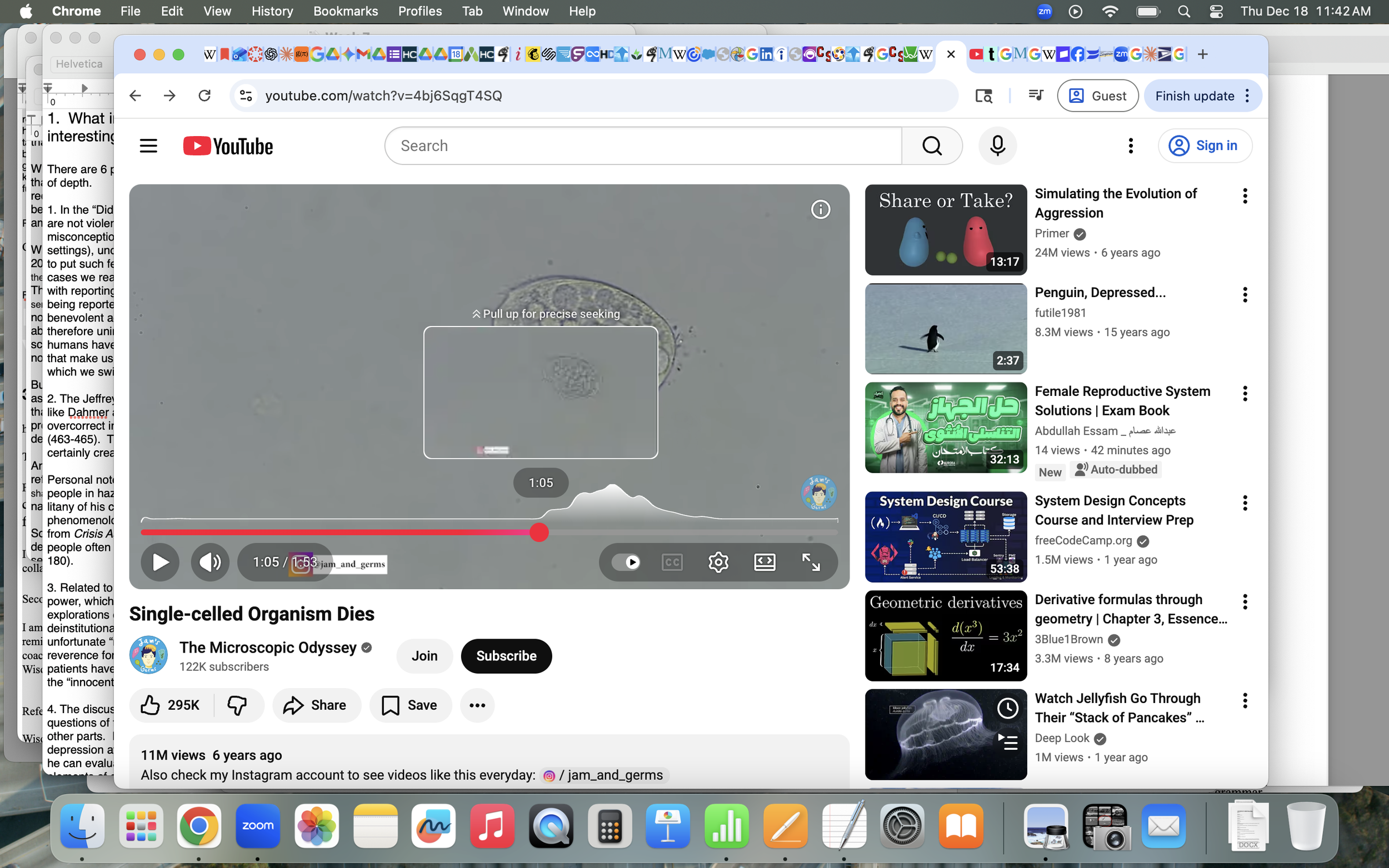
So, 1:18 is the closest we might come to a “moment of death”, with the 29 second window roughly containing the process of death, although the whole video could be said to be the process. So, where does it start and end? Can we really say that the process of death includes time past the moment of death? The shape of the view statistics in this video indicates that yes, we can, or else it would be hard to explain why people view as they do. If the process outlives the moment of death, we can ask if the shirt remains a shirt after it can no longer be a shirt - there is a mysterious metaphysical persistence past the disintegration of entity.
The moment is mysterious too, as are all moments. How far can we zoom in on the present moment? Here’s the first of my theoretical works:
In this essay I argue that the present moment doesn’t actually exist, because all we can really ever do is to remember what is past (result) and imagine where we intend to go (risk). The present moment is perched on the razor’s edge of a razor’s edge.
And this discussion of death presses us to search for it, to discover it phenomenologically. In spite of the convincing argument for death as a process, I think this single celled organism shows that it must be a moment, although our higher order complexity might complicate that, but perhaps not. As the text notes, it is fashionable for movies to show death as a moment, so there is something helpful for us to think of it that way. The cell in the video does seem to have a moment where the structural organization ceases to hold, but there is also an epilogue as the views decline. But that moment is the climax.
In the 1870s the German mathematician Richard Dedekind introduced the enduring concept of the “cut” which bears his name, the Dedekind cut, as he sought to explain why calculus works. How can we converge on irrational numbers like , , or as limits even though their decimal expressions defy precise capture and we can always zoom in to a finer degree? Dedekind showed us that we can divide real numbers into sets of those lower and higher than the limit, and that we can converge endlessly through increasing precision of rationals or decimal expansions, without ever reaching them. The number in question exists between each set as a border of infinitesimal width (Weisstein).
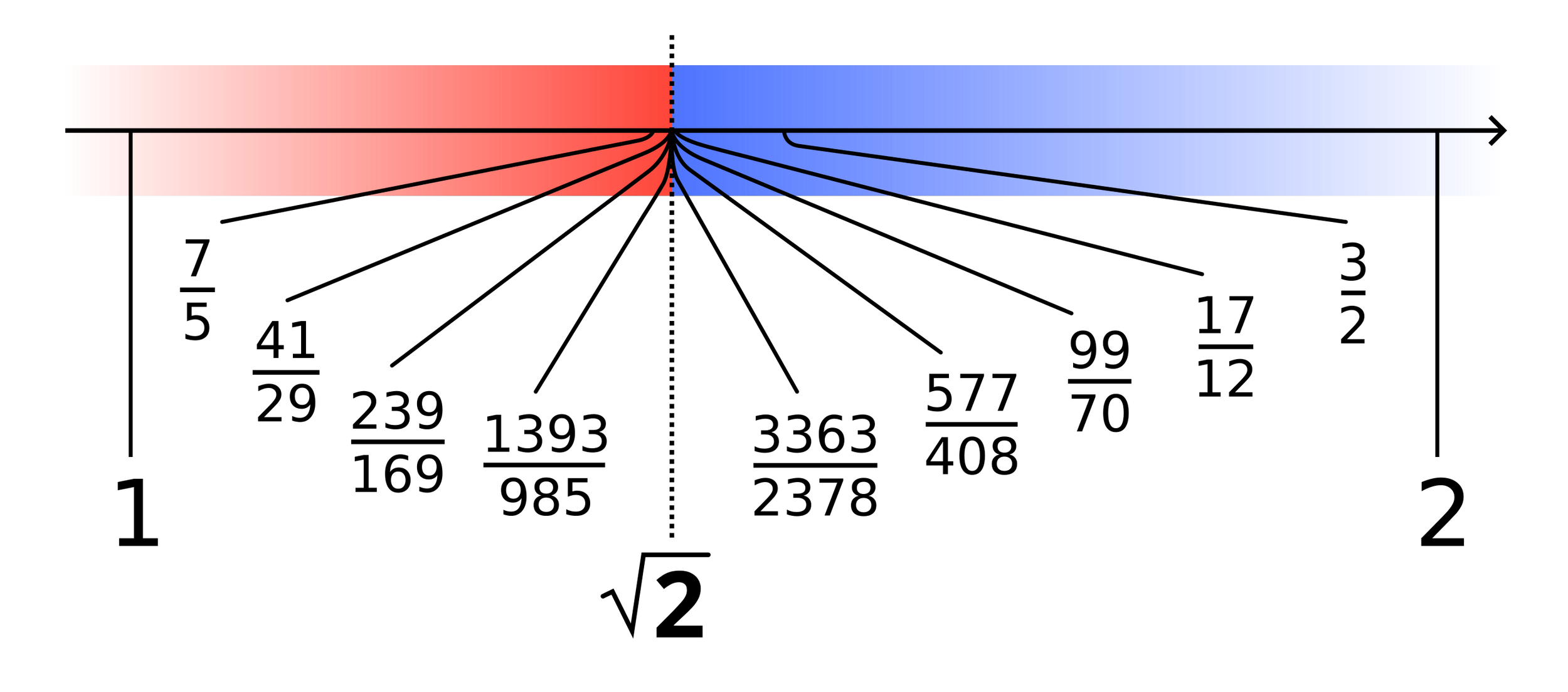
Is this how time works? The physicists tell us that there is a degree of resolution, called Planck time - the smallest meaningful unit of time, which is exactly the amount of time it takes for light to travel its companion unit of space, a Planck length (May, 2022). It is far below the threshold of human perception - that’s what a moment is. Yet, the moment is meaningful - and many such moments segment what was past from what approaches; all moments actually do, but not all with the same degree of significance and meaning.
Our continuity with the past and how it accompanies us into the future is precious, which is why changes in memory are so challenging and demoralizing (411). In the language of my aforementioned temporal phenomenology, our risks (the future) lack context or meaning without clear connection to our accumulated results.
The vitality of our integration seems directly related to fluid intelligence (410) and command of language (412). So, there is a dynamic, fluid adaptability that is synonymous with initiative, drive, and agentic health - a kind of metaphysical flow between and around our aims and objects in question. I was delighted by this characterization of language from page 412:
“The intrinsic value of language is that it acts as glue holding social groups together, providing a mechanism for shared ideas.”
Very elegant, and correct. I spend many more pages saying essentially the same thing in this work that investigates the deeper mechanisms behind human social groupings and traces a progression from metaphysics to valuation to groupings to rituals to semiotics:
SEEKING COMPLETIONLinks to an external site.
When we lose the signals of our groupings, which always cultivate shared values in each moment, we have a real sense of loss, and this is why both memory and fluid intelligence are essentially synonymous with integration of both persons and social groups, both of which are mereological entities of various scale.
And finally, on page 395 we see this similarly elegant and highly potent construction:
“Although science has yet to fully explain why people age, researchers do know that aging, senescence, and death represent a failure of the human body’s homeostatic dynamics.”
This year in particular I have been contemplating the nature of entity, and I continually arrive at the concept of homeostatic window. In order to persist, all entities must exist within a window that somewhat precisely balances change and stasis; we cannot have too much of either or else we lose integration, and I think homeostasis is what characterizes that window. This is true for all organisms and organizations, and we can think of the common etymology between government and cybernetics, both of which trace their lineage back to the Ancient Greek root “kuber”, meaning to steer. So, at disintegration the steering within that homeostatic window ceases and the entity ceases to persist.
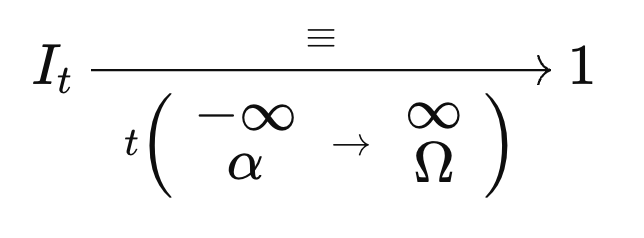
Given that all entities, organism or organization, are unitary, we can label them mathematically as "1", and 1 is a number on Dedekind’s line, so I would argue that all such entities that persist in homeostatic integration are constantly approaching the limit of 1 (unity), even as we label them “1”. This is the ultimate synthesis of the age-old question of being vs. becoming, and reveals that all existence is engaged in both at the same time - being is becoming and vice versa. And so death can be simultaneously moment and active process as Erford asks us to consider. But the the moment of death is when the dynamic ongoing autopoetic entity computation ceases to pursue that limit of unity and its components scatter to find new entities to join.
This year I have endeavored to formalize this tension as a language, called Dynamic Mereological Unity Calculus, or DMUC.
https://drive.google.com/file/d/1xp5q9faPCs0EbaRrskGYEmgUABGTcbI9/view?usp=sharing
I’ve only begun to do this, co-thinking with large language models, and this would not be recognized as computationally rigorous by mathematicians, physicists, or computer scientists. But it’s the beginning of a project. It may be doomed to failure because, as I already said, psychology has long resisted such formal definition for many good reasons. But, these are patterns that I can’t help but to see and personal tendencies I can’t help but to engage.
A much more succinct version is this identity that fuses ontology with mathematics. I is identity and t is time.
2. How does this reading apply to my future work as a counselor?
While I know that my sensibility is highly abstract, and some may find it difficult to access, my motivation is always highly relational and presence-oriented. All that I seek to formalize is the essence of the good we seek as we unfold through spacetime. Of course aging, dying, and ultimately death are important topics to understand well, and our work as counselors can become more sacred as we do and show up accordingly. Working in formal languages helps me to do this better; whether or not they get theoretical legs beyond my own sensibility, I believe they are helpful to me and my therapeutic presence.
What amazes me is how fascinated viewers are by the death throes of that single cell. The comments convey an actual religious resonance that indicates being put in touch with something sacred about existing and existence. Such is the nature of death, and that’s just a single cell. How much more, then, do we feel as we experience aging and death, and guide others as they experience it either from within or without?
Another concept from the reading that stood out to me is Durkheim’s anomie - a lack of moral alignment with the direction of society which is linked to higher rates of suicide (417). I recognize this problem deeply, and I often feel that complex societies like ours are animated by a runaway spirit seeking technological development that transcends us as individuals and that we cannot control, but that causes us stress and strain. We are not able to exempt ourselves from this, and so it is natural that suicide would be a response.
I don’t know how to solve this, or that it is solvable, but I do feel that I see the problem clearly, and recognize the tradeoffs inherent in questions of societal development.
Here are the three essays I have written that relate to this in some way:
PIRAHA (Counting Without Numbers)
At the very least I can help people to discern the shape of this as I counsel them, which will be helpful. But perhaps I could motivate a movement that seeks systemic change. This is a stiff challenge though. The fundamental generative dialectic of Western civilization is inscribed within the inner perimeter of the classic dome of the Museum of Science and Industry in Chicago, which I will visit with my family over holiday break:
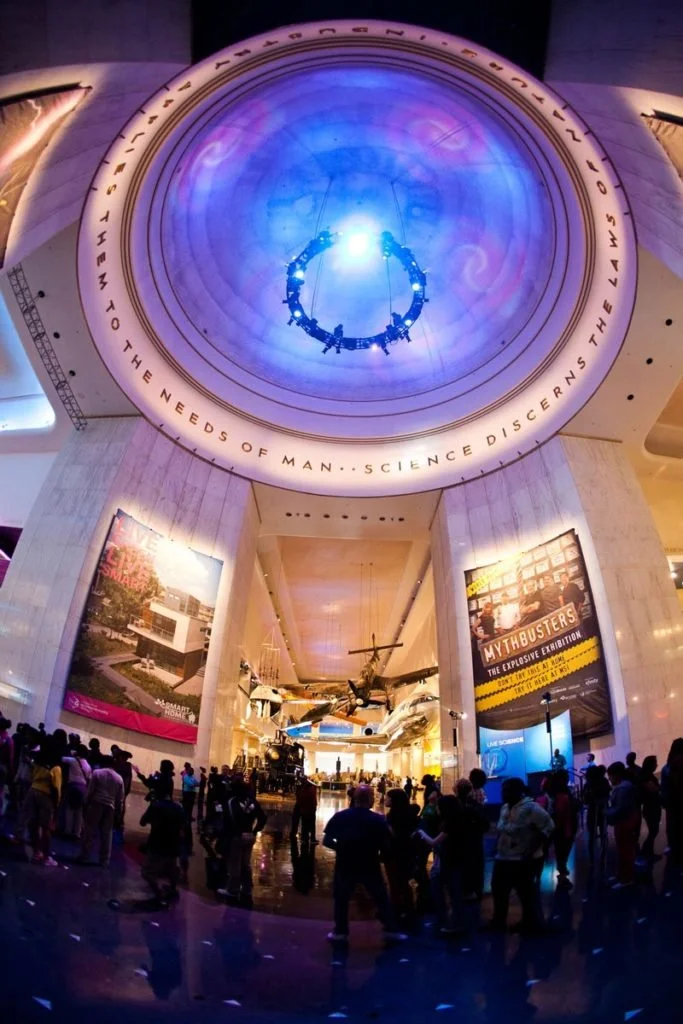
(Science Discerns the Laws of Nature) 🔄 (Industry Applies Them to the Needs of Man)
We can’t escape this - it’s been turning for thousands of years and I am convinced that it is the very engine that drives our Western neurosis. The Piraha are spared from this, one of the less complex societies Dirkheim notes. We must find our flow within it - for us that is the essence of mental health.
3. What questions do I have now that I have this new information?
None at this time. It’s been a long semester and I’m tired! I learned a lot though and enjoyed the community here. Thanks everyone, and thanks for reading if you made it this far 😄
References:
Erford, B. T. (2017). An Advanced Lifespan Odyssey for Counseling Professional (1st ed.). Boston,
MA: Cengage Learning.
May, A. (2022). What is the Planck time? Space.com. https://www.space.com/what-is-the-planck-
The Microscopic Odyssey. (2018). Single-celled organism dies. [YouTube Video].
https://www.youtube.com/watch?v=4bj6SqgT4SQ
Stangroom, J. And Garvey, J. (2005). The Great Philosophers. Metro Books.
Weisstein, Eric W. "Dedekind Cut." From MathWorld--A Wolfram